

AI Voice Agents
Human-like voice automation.
Inbound and outbound voice agents integrated with telephony, CRM, scheduling and support workflows. We build agents that hold natural conversations, respect latency budgets and hand off cleanly to humans. Each deployment covers speech pipelines, dialogue logic, integrations and monitoring. Engineered as production systems, not demos.
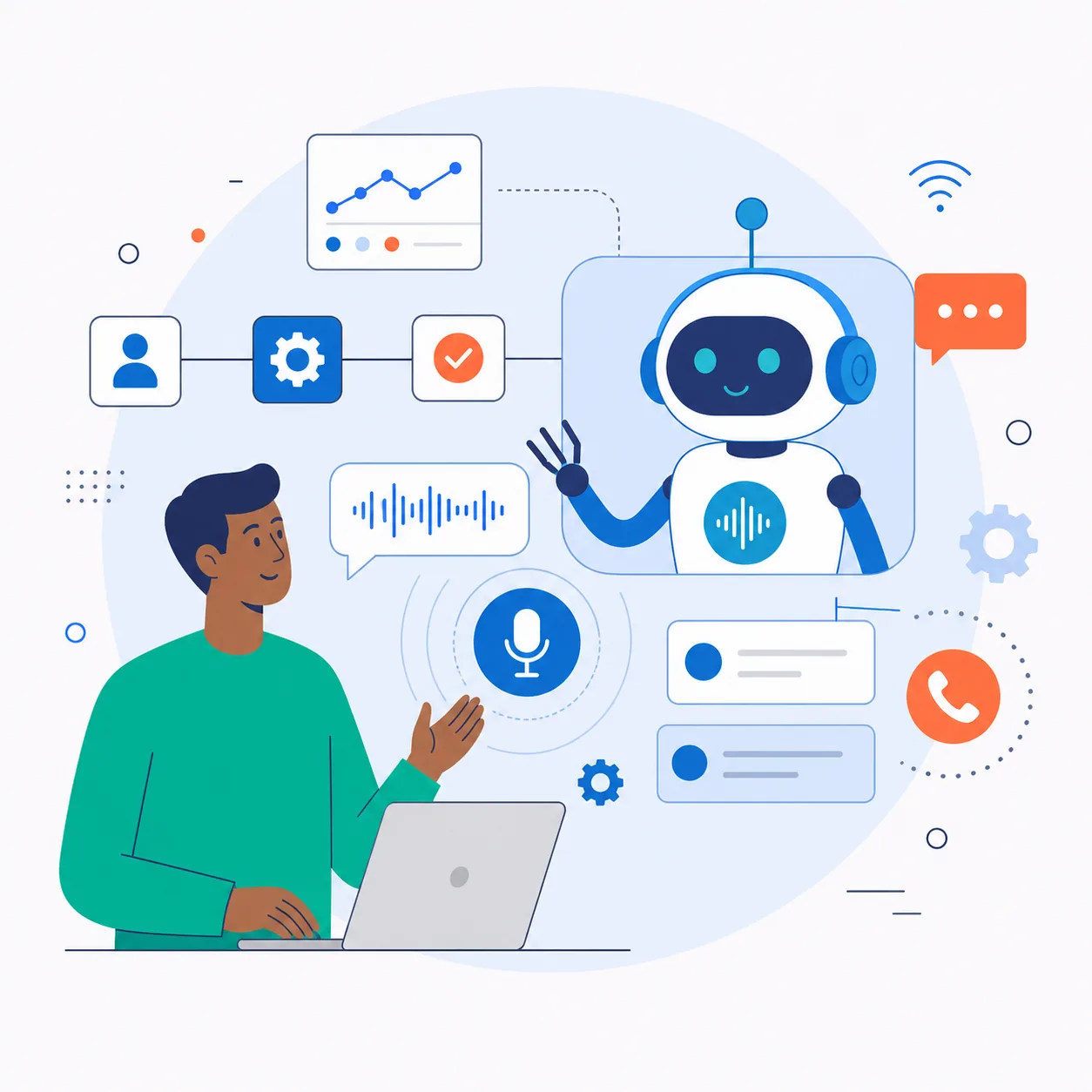
AI voice agents are automated phone-call systems that combine speech-to-text, an LLM for dialogue and turn logic, and text-to-speech into a pipeline that answers or places calls. Inbound agents handle reception, qualification and appointment booking; outbound agents handle reminders and follow-up. Latency budget, escalation rules and CRM/ticketing integration are engineered per deployment, not left to defaults.
- End-to-end voice pipelines: telephony, STT, LLM dialogue, TTS
- Turn-latency engineering with streaming and barge-in support
- CRM, calendar and ticketing integrations with function calling
- Escalation and human-handoff flows with full call context
- Call analytics, transcription review and quality monitoring
1. Discovery
We map your requirements, constraints, existing systems and success criteria before proposing a solution.
2. Architecture
We design the system architecture, interfaces and technology choices, documented and reviewed with your team.
3. Implementation
We build in short iterations with working increments, code review and continuous integration from day one.
4. Validation
We test against real conditions — hardware, load, failure modes — and report measured results, not assumptions.
5. Deployment
We ship to production with monitoring, documentation and a handover that leaves your team in control.
Where benchmarks are required, Gengini documents throughput, latency, test platform, workload, and measurement method.
Technologies
- Deployed voice agent on your telephony stack
- Dialogue design and integration specification
- Latency measurement report per pipeline stage
- Monitoring dashboard with call outcomes and transcripts
- Escalation playbook and admin documentation
How fast do your voice agents respond?
We engineer for sub-second turn latency using streaming STT, incremental LLM generation and streamed TTS, and we measure each stage so regressions are visible. Actual figures depend on telephony path and model choice, and we report them per deployment.
Can the agent hand off to a human?
Yes. Escalation is designed in from the start: the agent transfers the call with a summary and full transcript, and rules define when handoff is mandatory.
Which systems can the agent integrate with?
Anything with an API — CRMs like HubSpot or Pipedrive, calendars, helpdesks and internal systems. We typically orchestrate integrations through n8n so workflows stay maintainable.
Do you need a cloud telephony provider like Twilio?
Usually, for volume and reliability. For low-volume or single-line use cases we've also built agents on a physical SIM and Android phone bridged over Bluetooth HFP, avoiding per-minute billing — the right choice depends on call volume and cost sensitivity.
Can the agent open a support ticket during a call?
Yes. Ticket generation is typically a function call the LLM invokes mid-conversation, writing structured fields (issue type, priority, contact details) into your helpdesk rather than a free-text summary you'd have to re-parse.
How do you measure and reduce turn latency?
We instrument each pipeline stage — STT, LLM time-to-first-token, TTS — separately, since 'the agent feels slow' is not actionable on its own. Optimization then targets whichever stage the measurement shows is dominant, in priority order of impact to effort.
Building a SIM-Based AI Voice Agent Without Per-Minute Telephony Billing
How to build an AI voice agent that answers real phone calls using an Android phone, ADB, and Bluetooth HFP instead of per-minute telephony APIs.
Reducing Voice Agent Turn Latency: Practical Optimization Techniques
Concrete, prioritized optimization techniques for reducing voice agent turn latency across STT, LLM, and TTS stages, based on measured impact.
AI Voice Agent Architecture: Phone Service, ADB, Bluetooth HFP, and Workflow Engine
A reference architecture for AI voice agents built on physical telephony hardware, covering the phone service layer, ADB control plane, HFP audio bridge, and workflow engine.
AI Automation
AI workflow automation, voice agents, CRM automation, content automation and operational AI systems.